Picture of a workers in manufactoring factory

Produce with confidence

DECATHLON runs its business throughout the world, with manufacturing activities in many countries and a commercial presence in even more countries.
Where are the products made? Who makes our products and in what conditions? What are our commitments?

How are DECATHLON products produced?

Supply chain

Developing industrial multi-process solutions

The company offers a wide range of sports items in line with user requirements for five brands. These products, designed by the DECATHLON teams and suppliers, are manufactured using a number of industrial processes, including those in sectors such as textiles, metallurgy, electronics, footwear, etc. The products are designed and manufactured in compliance with DECATHLON’s specifications and contracts, which include its social and environmental requirements.
Controlling the supply chain

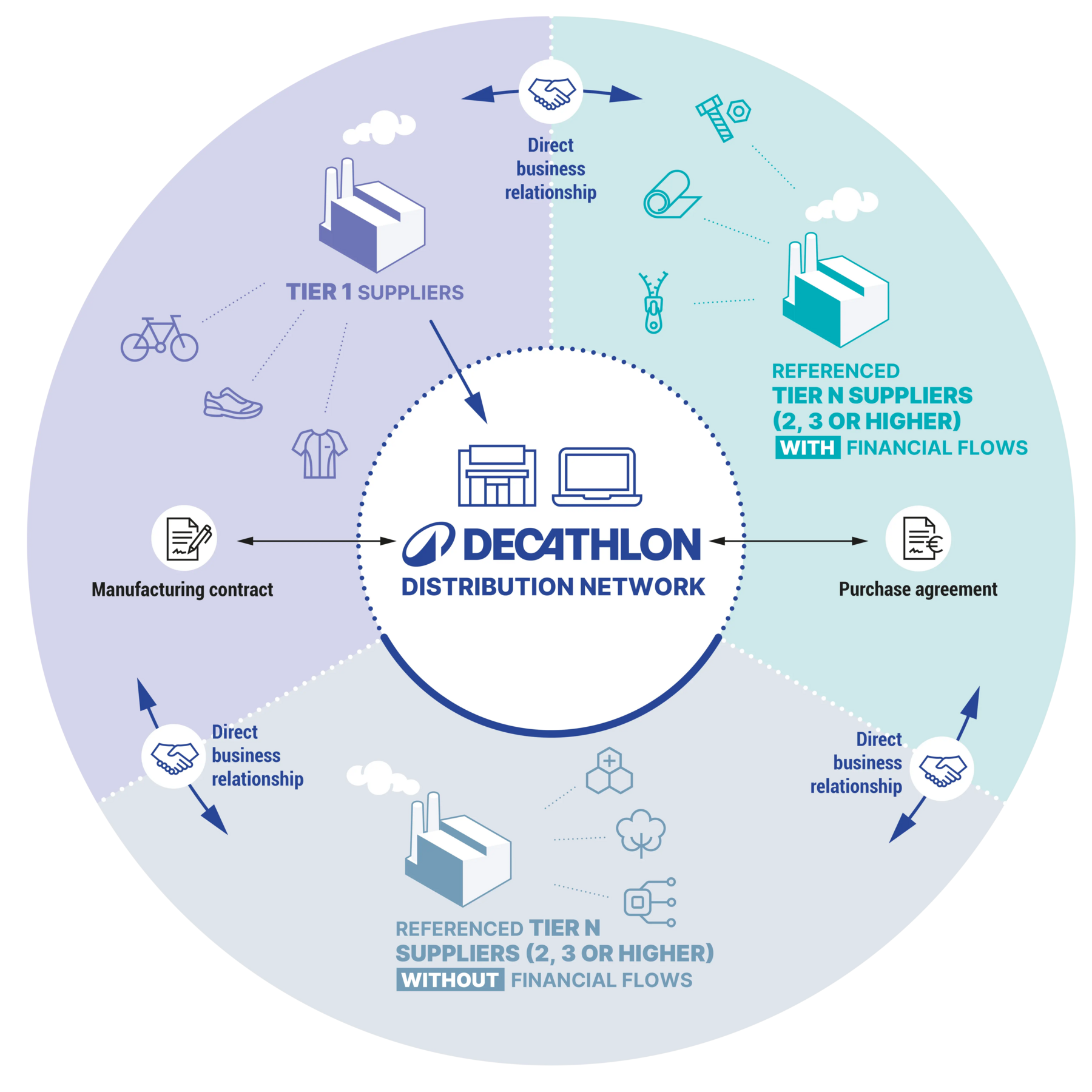
Referenced Tier 1 suppliers with financial flows
Tier 1 suppliers are bound contractually to a company within the Decathlon group for the manufacture and/or assembly of finished and semi-finished products (via a manufacturing agreement), destined for sale throughout the Decathlon Group distribution network (stores, e-commerce and franchises).

Referenced Tier N suppliers with financial flows
Referenced Tier N suppliers (2, 3 or higher) with financial flows are bound contractually to a company within the Decathlon Group for the supply of processed materials and/or components (via a purchasing contract), to be provided to Tier 1 or Tier N suppliers for the manufacture and/or assembly of finished products.

Referenced Tier N suppliers without financial flows
Referenced Tier N suppliers (2, 3 or higher) without financial flows with the Decathlon Group contribute to the Decathlon value chain and have a direct commercial relationship with Tier 1 or Tier N suppliers for the supply of processed materials and/or components necessary for the manufacture and/or assembly of finished products. Decathlon can intervene in the selection of referenced Tier N suppliers without financial flows, but does
not interfere in the commercial and legal relationship between Tier 1 and Tier N suppliers. The methodology and decision on prioritisation and guidance regarding issues associated with these suppliers is being finalised.

To go further

Picture of a blue fabric

Decathlon and the Commitment and Well-being Survey

Why did Decathlon sign up to do the Commitment and Well-being Survey project?

Photo de la mer

Conducting environmental audits - DECATHLON's audit system

Why do we carry out audits of environmental standards? At what type of suppliers do we perform environmental audits?

What action plan is needed to reduce absolute CO2 eq emissions?

What action plan is needed to reduce absolute CO2 eq emissions?

DECATHLON commits to reduce absolute scope 1 and 2 GHG emissions 42% by 2030 from a 2021 base year. Decathlon also commits to reduce absolute scope 3 GHG emissions 42% within the same timeframe.